
For any researcher, publishing a paper in a reputable conference is a primary goal. However, this process is governed by a strict set of ethical rules. Understanding these rules is not optional; it is a fundamental duty. A breach of publishing ethics, even if unintentional, can lead to your paper being retracted, your reputation being damaged, and in severe cases, academic sanctions.
This guide provides a clear overview of the essential "do's and don'ts" to ensure your conference submissions are always professional and ethical.
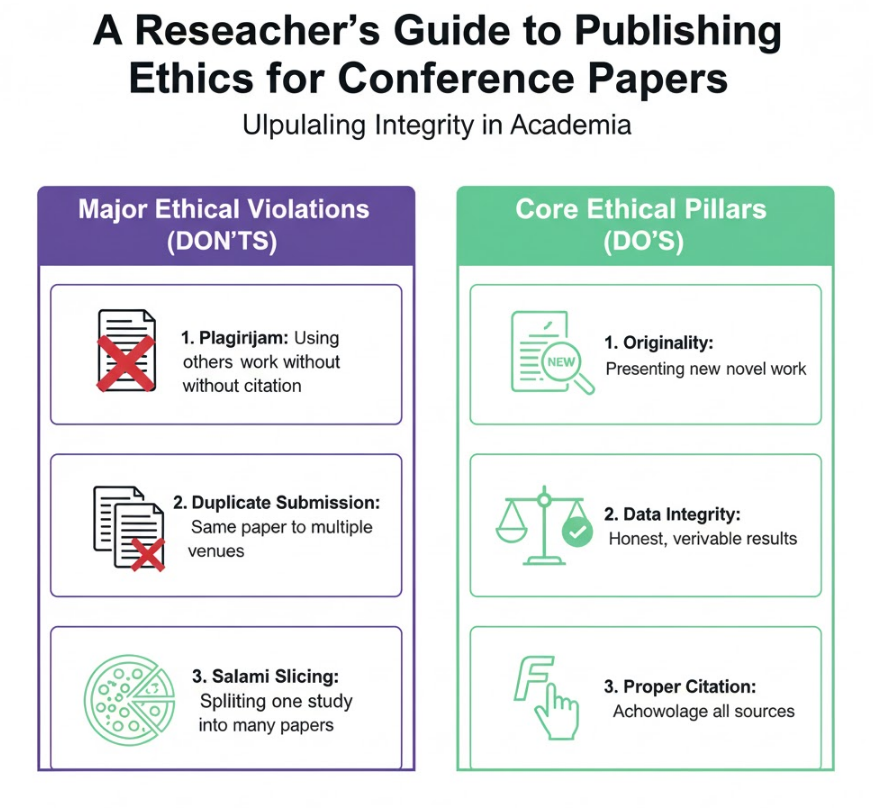
All rules of publishing ethics are built on a foundation of trust. Your readers, reviewers, and the scientific community must be able to trust that your work is original, honest, and that you have given credit where it is due.
1. Originality and Novelty Your paper must be substantially new. It cannot be a re-submission of work that has already been published elsewhere. It must present a new idea, a new methodology, new data, or a new analysis that represents a genuine contribution to the field.
2. Honesty and Integrity in Data Your research must be based on data that was honestly obtained and reported.
Data Fabrication: This is the act of "making up" data or results.
Data Falsification: This is the act of manipulating, changing, or selectively omitting data to support a desired conclusion.
Both are considered severe academic misconduct. You must report what you found, not what you wished you had found. All your data, code, and methods should be available for verification upon request.
3. Proper Citation and Acknowledgment This is the antidote to plagiarism. You must comprehensively cite all work that influenced your paper. This includes:
Ideas, theories, and methods from other researchers.
Direct quotations (which must be enclosed in quotation marks).
Figures, tables, or data borrowed from other sources.
Even your own previously published work.
4. Transparency and Disclosure You must be transparent with the conference organizers and your readers. This includes disclosing:
Conflicts of Interest (COI): Any financial, personal, or professional relationships that could be perceived as biasing your work. (e.g., "This research was funded by Company X, which sells the product we are testing.")
Sources of Funding: Acknowledging the grants or organizations that supported your research.
These are the most common and serious "don'ts" in academic publishing.
What it is: Using another person's ideas, words, figures, or code without giving them explicit credit. Plagiarism is theft of intellectual property. How to avoid it: Always cite your sources. When in doubt, cite it. Paraphrase ideas into your own words and still cite the original source. Use plagiarism-checking software before you submit.
What it is: This is a critical rule for conferences. It means submitting the exact same paper to two or more different conferences (or a journal and a conference) at the same time. Why it's wrong:
Wastes Resources: You are wasting the valuable, unpaid time of two separate sets of reviewers.
Copyright Issues: If both venues accept your paper, you will have a serious legal problem, as you can only transfer the copyright to one publisher. The rule: You must wait for an official decision (accept or reject) from the first conference before you can submit that paper to another one.
What it is: This is different from duplicate submission. Salami slicing is the act of splitting one single, comprehensive research study into multiple "thin" papers to get more publications. Why it's wrong: It fragments the scientific literature and misleads readers into thinking there are multiple independent studies when there is only one. The rule: Each published paper must have a substantial, new, and self-contained contribution. If two of your papers are so similar that they share the same hypothesis, methodology, and data, they should probably be a single, stronger paper.
What it is: Reusing large portions of text from your own previously published papers without proper citation. Why it's wrong: This is a form of deception, as it presents old work as if it were new. It can also be a copyright violation, as you may have already transferred the copyright of the original text to the first publisher. The rule: While some minor overlap in a "Methodology" section is sometimes tolerated, it is best practice to always rewrite your text and cite your previous work (e.g., "Our experimental setup follows the procedure we previously detailed in [Citation]").
Determining who gets to be an author on a paper is a major source of ethical disputes.
Authorship should be reserved for individuals who made a substantial intellectual contribution to the research. This includes:
Significantly contributing to the conception and design of the study.
Acquiring, analyzing, or interpreting the data.
Drafting or critically revising the article for intellectual content. AND all authors must approve the final version of the paper before submission.
"Gift" or "Guest" Authorship: Adding a senior professor's name to your paper to add prestige, even though they did not contribute intellectually. This is unethical.
"Ghost" Authorship: Failing to credit someone who did make a substantial intellectual contribution.
Individuals who only provided funding, technical help (like running a machine), or general supervision are not authors. They should be listed in the "Acknowledgments" section.
If you are invited to be a reviewer for a conference:
Confidentiality: The paper you are reviewing is a confidential document. You cannot share it, discuss it, or use its ideas for your own research.
Objectivity: You must provide an unbiased, constructive review. If you have a conflict of interest (e.g., you are a direct competitor, a close friend, or a recent co-author of the author), you must decline the review.
Publishing ethics is the non-negotiable price of entry into the academic community. Your most valuable asset as a researcher is not your list of publications, but your reputation for integrity. By adhering to these core principles, you ensure that your work can be trusted, respected, and built upon by others.