
For any researcher, especially in engineering and computer science, publishing in a conference indexed by EI Compendex is a critical goal. It's often a requirement for graduation, funding, or promotion. However, many predatory conferences falsely claim "EI Indexing" to attract submissions.
So, how do you verify their claims? The only way to be 100% certain is to check the historical data yourself. This guide provides a step-by-step method to find a conference's past indexing records.
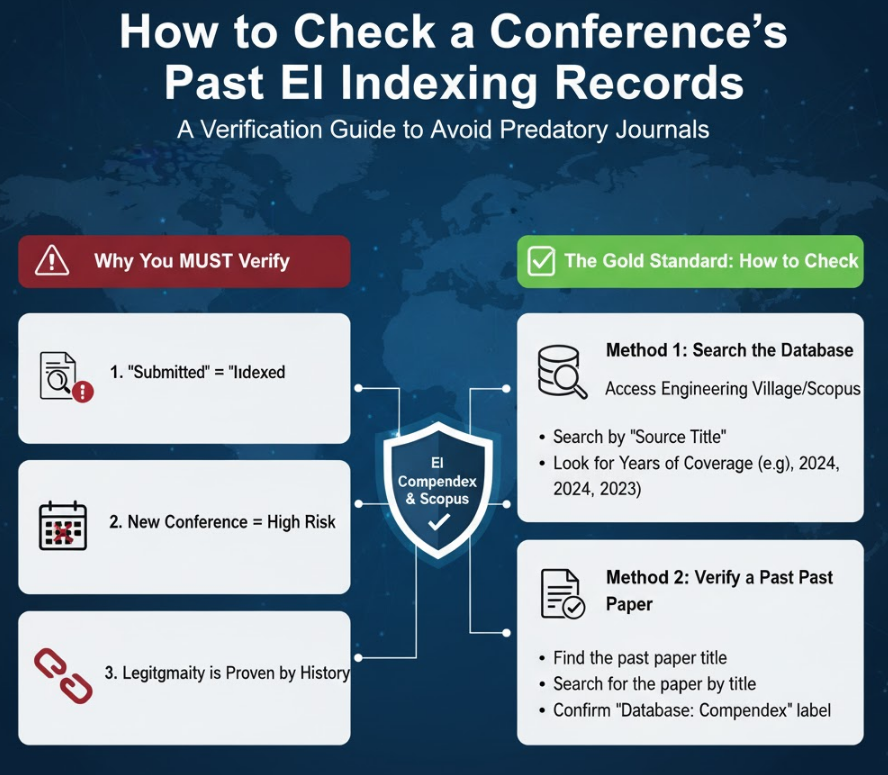
The academic world is full of "predatory" conferences. They make bold promises but deliver no value.
"Submitted for EI Indexing" is NOT "Indexed by EI." Submission does not guarantee acceptance.
A "New" Conference is a Risk. A conference in its 1st or 2nd year has no indexing record, making it a gamble.
Legitimacy is Proven by History. A legitimate conference series (e.g., one in its 8th, 10th, or 15th year) will have a verifiable record of its past proceedings being indexed.
The most definitive method is to search the Engineering Village (EV) platform, which is the official home of the EI Compendex database.
Note: Engineering Village is a premium, subscription-based service. You will almost certainly need to access it through your university's library portal or institutional subscription.
This is the most direct way to see what EI Compendex has on record for a specific conference series.
Access Engineering Village: Log in through your university library's database portal.
Select "Compendex": Ensure you are searching within the Compendex database.
Find the "Conference" Search Field: On the main search page, look for the "Search in" drop-down menu. By default, it's on "All fields." Change this to "Conference information."
Enter the Conference Name:
Try the Acronym: e.g., ICMRE or AAIEE
Try the Full Name: e.g., "International Conference on Mechatronic Engineering and Robotics" (use quotes for an exact match).
Analyze the Results:
The search results will show you all papers from that conference that are indexed.
Look at the "Year" on the left-hand filter. Do you see papers from 2024, 2023, 2022, etc.?
Click on any paper and scroll down to the "Conference information" field. It should list the full conference name, date, and location.
If you see a consistent record over the past several years, you can be highly confident that the conference series is legitimate and reliably indexed.
If the "Source" search is unclear, you can verify a specific paper from a past event.
Find a Past Paper: Go to the conference's official website. Look for its "Past Proceedings" or "Archives" for 2024, 2023, etc. Find the title of any paper published in a previous year.
Access Engineering Village: Log in through your library.
Search for the Paper Title: Keep the search field on "All fields" and paste the paper's title (use quotation marks "" around the title for an exact match).
Check the Database: If the paper appears in your search results, look for the "Database: Compendex" label. This confirms that this specific paper from the conference's past event was successfully indexed.
Since Scopus (also owned by Elsevier) includes all Compendex data, it is an excellent and often easier-to-use tool for verification. The process is very similar.
Access Scopus: Log in through your university library.
Choose Your Search Type:
Option A (Best): Click on the "Sources" tab (instead of "Documents"). In the "Title" search box, enter the full name of the conference (e.g., "International Conference on..."). If Scopus tracks it as a regular source, it will appear here with its coverage years.
Option B: Stay on the "Documents" tab. Select "Conference" from the drop-down search field and enter the conference name.
Analyze the Results: Just like in Engineering Village, check the results to see if papers from past years (2024, 2023, etc.) are listed. This proves a historical record.
You can also consult the publicly available lists that Elsevier publishes.
Go to a search engine and look for "EI Compendex source list" or "Elsevier indexed conference list."
This will usually lead you to an official Elsevier page with a downloadable Excel file.
You can search this file for the conference name or its ISSN/E-ISSN (if it has one).
Limitation: This list shows what is currently indexed but may not be as comprehensive for checking historical data as searching the database itself.
No Past Records Found? If you search EI Compendex and Scopus and find zero results for a conference that claims to be in its 10th year, this is a massive red flag.
Vague Website: The conference website has no archive, no links to past proceedings, and no information about where past papers were published.
"Submitted to..." vs. "Indexed in...": As stated before, "submitted" means nothing. Only "indexed" matters.
Conclusion: Trust, but verify. The only proof of a conference's indexing is its past record. Taking 10 minutes to check the Engineering Village or Scopus database can save you hundreds of dollars, months of wasted time, and the embarrassment of publishing in a predatory venue.