
For PhD students and researchers, a conference paper is often the first step in disseminating new findings. However, with acceptance rates at top-tier IEEE and ACM conferences often dropping below 20%, the competition is fierce.
Getting a paper accepted—and subsequently indexed in EI Compendex or Scopus—requires more than just good data. It requires a strategic approach to writing, structuring, and formatting.
This step-by-step guide outlines the blueprint for writing a conference paper that reviewers will want to accept.
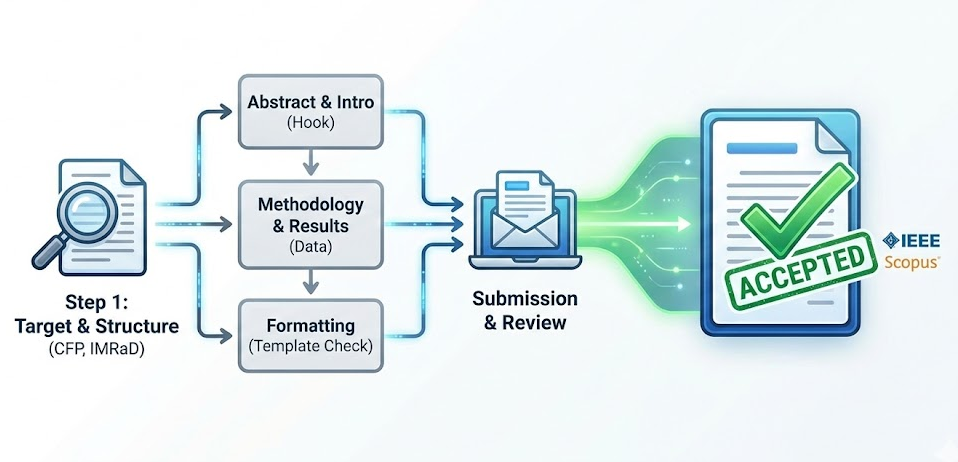
The most common reason for rejection is "out of scope." Before writing a single word, study the Call for Papers (CFP).
Match the Topic: Does your research align exactly with the conference's tracks?
Check the Format: Are they asking for a 4-page short paper or an 8-page full paper?
Verify Indexing: Ensure the conference guarantees publication in proceedings indexed by EI Compendex or Scopus.
Most engineering and computer science papers follow the standard IMRaD structure. Sticking to this familiar format helps reviewers understand your work quickly.
Introduction: What is the problem, and why does it matter?
Methodology: How did you solve it?
Results: What did you find?
Discussion: What do the results mean?
Reviewers are busy. They often decide whether to advocate for your paper based solely on the Abstract and Introduction.
The Abstract: This is your "elevator pitch." It must summarize the background, problem, proposed solution, and key result in 200-250 words. Tip: Do not use citations in the abstract.
The Introduction: This section must clearly define the "Research Gap." Show what existing studies have done (Literature Review) and explicitly state what they missed. Then, state: "In this paper, we propose..." This highlights your unique contribution.
In technical fields, your methodology must be reproducible.
Use block diagrams to explain complex systems.
Clearly state your algorithms, equations, or experimental setups.
If you are using a dataset, specify its source and size clearly.
Engineers trust data. Your results section should be the strongest part of the paper.
Compare Baselines: Do not just show your results; compare them against state-of-the-art (SOTA) methods.
Use High-Quality Figures: Blurry or unreadable charts are a major red flag. Ensure all axis labels and legends are legible in black and white.
Many papers are "desk rejected" (rejected without review) simply because they didn't follow the formatting rules.
Use the Template: Download the official IEEE or ACM LaTeX/Word template and use it from the start.
Check References: Ensure your bibliography is up-to-date. Citing papers from 2024-2026 shows your work is current. Avoid excessive self-citation.
Writing a conference paper is an exercise in precision. You have a limited page count to convince a critical expert that your work is novel and valid. By following this structure, strictly adhering to the template, and clearly articulating your contribution, you significantly increase your chances of seeing that coveted "Accepted" notification.