
Getting a paper accepted at a top-tier academic conference is a major milestone. It's not just about having good research; it's about packaging that research into a compelling narrative that convinces busy reviewers of its value.
The competition is fierce, with acceptance rates at top venues often below 20%. To succeed, you need a strategic approach. This guide will walk you through the entire lifecycle of a successful conference paper, from the initial concept to the final submission.
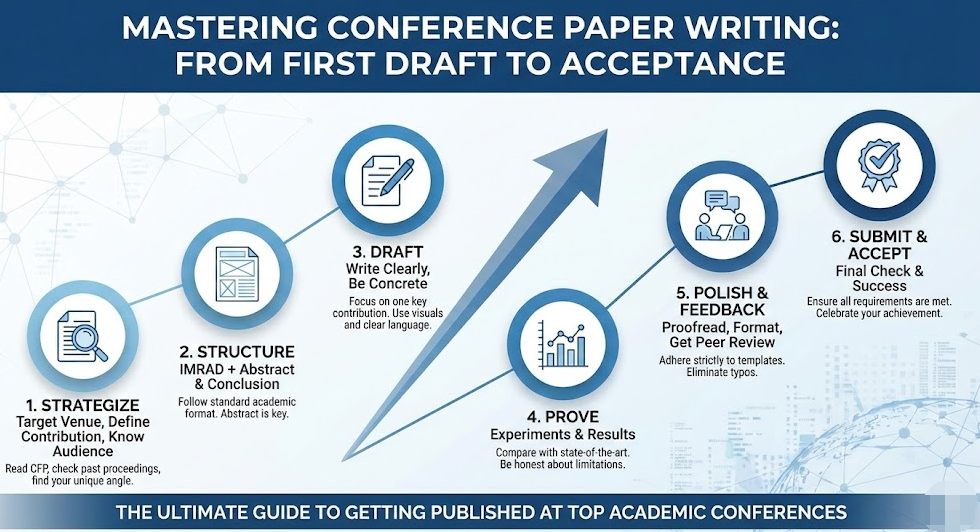
The most common mistake is starting to write too soon. A successful paper begins with a clear strategy.
Your paper must be a perfect fit for the venue. A brilliant paper on machine learning will be swiftly rejected by a pure mathematics conference.
Read the Call for Papers (CFP): Carefully study the conference's scope and topics. Does your research align perfectly with one of them?
Check Past Proceedings: Look at papers accepted in the last 2-3 years. What is their style, length, and level of technical depth? This is your benchmark.
A conference paper is short. It cannot solve every problem. It must have one clear, novel contribution.
The "Elevator Pitch": Can you summarize your paper's unique value in one sentence? If not, your contribution isn't clear enough yet.
Example: "We propose the first algorithm that solves problem X with linear time complexity, outperforming the state-of-the-art quadratic solutions."
Reviewers are busy experts who are often reading your paper late at night. They are looking for reasons to reject it. Your job is to make it easy for them to say "accept."
Write for a knowledgeable peer, not a novice. You don't need to explain basic concepts, but you do need to clearly explain your specific innovation.
Follow the standard structure of your field. Reviewers expect it. A typical structure for scientific and engineering papers is IMRAD (Introduction, Methods, Results, and Discussion), often with a Conclusion.
This is the most important paragraph in your paper. It is often the only thing reviewers read to decide if they want to review the paper.
Follow the
Be concrete. Don't say "results showed improvement"; say "our method improved accuracy by 15%."
The introduction must convince the reader that the problem is important and that your solution is novel.
The Funnel Approach: Start broad (the general field), narrow down to the specific problem, discuss the limitations of existing solutions (the "gap"), and then state your contribution clearly.
State Your Contributions Explicitly: Use a bulleted list to tell the reviewer exactly what is new: "The main contributions of this paper are: 1)... 2)... 3)..."
This section proves you are not reinventing the wheel.
Don't just list papers. Group them by theme and explain their limitations. "While [1] and [2] address this problem, they fail to consider X, which is the focus of our work."
Be generous but critical. Acknowledge prior work but clearly delineate how yours is different and better.
This is the technical heart of your paper. It must be clear, precise, and reproducible.
Use diagrams, flowcharts, and pseudocode. A picture is worth a thousand words, especially for complex systems.
Define all symbols and acronyms on first use.
Your claims are worthless without evidence.
Compare with the State-of-the-Art: You must compare your method against the current best solutions using standard datasets or benchmarks.
Be Honest: Report both successes and failures. A discussion of why your method fails in certain cases adds credibility.
Visuals Matter: Use clear, professional graphs and tables. Every figure must have a caption and be explicitly discussed in the text.
Summarize your key findings and their implications. Don't just repeat the abstract. End with a thought on future work, showing that this research opens new doors.
A great idea written poorly will be rejected. A good idea written perfectly has a fighting chance.
Strictly adhere to the conference's formatting template (LaTeX or Word).
Page limits are hard rules. If the limit is 8 pages, do not submit 8.5 pages.
Follow all rules for font size, margins, and citation style. A paper that looks unprofessional is easy to reject.
Typos and grammatical errors signal carelessness.
Get Feedback: Have colleagues or mentors read your draft. They will find issues you've become blind to.
Read it Aloud: This is the best way to catch awkward phrasing.
Use Tools: Tools like Grammarly can catch basic errors, but they are no substitute for a human reader.
Before you click "submit," check everything one last time:
Is the PDF correctly formatted?
Are all figures clear and legible?
Have you blinded the paper for double-blind review (removed author names and affiliations)?
Writing an acceptable conference paper is a craft. By starting with a clear strategy, following a proven structure, and meticulously polishing your final draft, you can significantly increase your chances of success. Remember, your goal is to make the reviewer's job easy—make your contribution so clear and your evidence so compelling that "accept" is the only logical choice.