
In the competitive world of academic research, where you publish is just as important as what you publish. When selecting a conference, the first question researchers usually ask is: "Is it indexed?"
Two names dominate this conversation: EI Compendex and Scopus. While both are owned by Elsevier and represent a stamp of quality, they serve different purposes and hold different weights depending on your field of study and your institution's requirements.
This guide breaks down the key differences between EI and Scopus to help you determine which indexing status matters more for your research career.
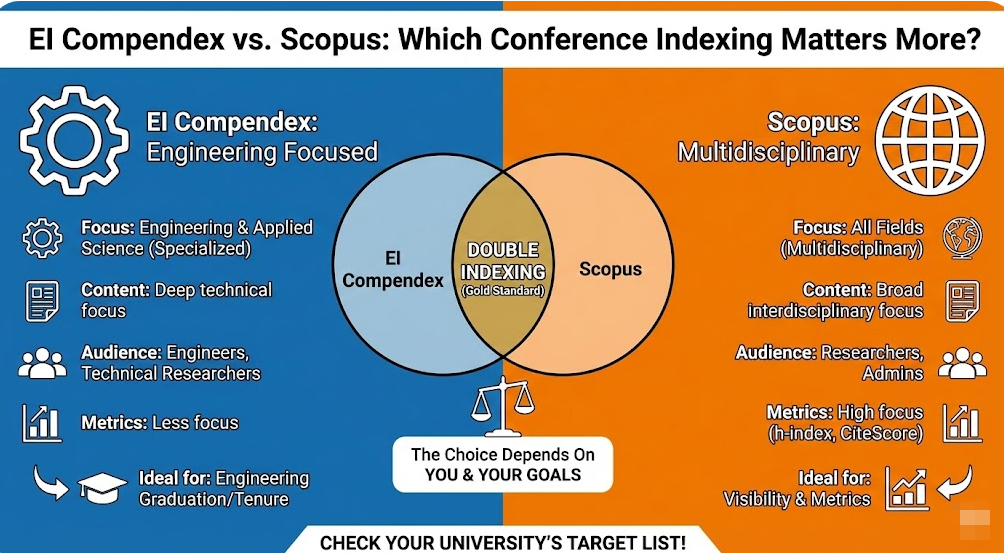
EI Compendex (Engineering Index) is the most comprehensive bibliographic database dedicated specifically to engineering literature.
The Focus: It is laser-focused on engineering and applied sciences.
The Depth: It is renowned for its depth in technical details. If you are an engineer writing a technical paper, EI is your home turf.
The Prestige: In many Asian universities and specific engineering departments worldwide, EI Compendex is considered the "Gold Standard" for graduation and promotion.
Scopus is the largest abstract and citation database of peer-reviewed literature in the world.
The Focus: Scopus is multidisciplinary.
The Strength: Scopus excels in citation analysis.
The Visibility: Because it is so large and widely used for university rankings (like QS and THE), having a Scopus profile ensures high visibility for your author metrics.
| Feature | EI Compendex | Scopus |
| Subject Focus | Engineering & Applied Science (Specialized) | All Fields (Multidisciplinary) |
| Content Depth | Deep technical focus. | Broad interdisciplinary focus. |
| Citation Metrics | Less focus on metrics. | High focus (h-index, CiteScore). |
| Primary Audience | Engineers, Technical Researchers. | Researchers in all fields, University Admins. |
| Strictness | Very strict criteria for engineering relevance. | Strict quality criteria, but broader scope. |
The answer is not a simple "one is better than the other." It depends entirely on who you are and who is evaluating you.
You are an Engineering Student/Faculty: In China, Southeast Asia, and many technical institutes globally, EI indexing is often a hard requirement for PhD graduation or faculty tenure in engineering departments.
Your Topic is Highly Technical: If your paper is about specific algorithms, mechanical structures, or circuit design, the EI audience is more relevant.
You Want to Prove Technical Rigor: Being in EI Compendex proves your work meets the specific standards of the engineering community.
You Work in an Interdisciplinary Field: If your work crosses boundaries (e.g., Bio-engineering, FinTech, Social Computing), Scopus provides better visibility.
You Care About Metrics: If you are focused on building your h-index and tracking who cites your work, Scopus is superior.
You Are in a Non-Engineering Science: For fields like Medicine, Biology, or Social Sciences, EI is irrelevant; Scopus is the standard (alongside Web of Science).
Ideally, you shouldn't have to choose. Top-tier engineering conferences are almost always indexed by BOTH EI Compendex and Scopus.
IEEE, ACM, and Springer conferences usually guarantee double indexing.
When you see a conference claiming "EI & Scopus Indexing," it is generally a safer and more prestigious venue than one indexed by only one database (especially for engineering).
If you must choose:
Go with EI Compendex if you are a pure engineer or computer scientist looking to meet specific institutional graduation/promotion requirements.
Go with Scopus if you want broader visibility, better citation tracking, or if your research is interdisciplinary.
Always check your university’s specific "Target Journal/Conference List" before submitting. That list determines which index truly matters for you.