With thousands of academic events hostedannually, distinguishing a prestigious international conference from apredatory money-making scheme is a necessary skill for modern researchers.Predatory organizers have become highly sophisticated, cloning legitimatewebsites and fabricating academic partnerships to collect registration fees.
Before you submit your manuscript, transfercopyright, or pay a registration fee, you must perform a background check onthe event's organizers.
Here is the definitive step-by-step guideto verifying the legitimacy of an academic conference and its organizingcommittee.
1. Investigate the Primary Organizer andSponsors
The first step is to identify who isfinancially and legally responsible for the event. Legitimate conferences aretypically backed by established scientific societies, recognized universities,or major publishers.
- Check the Parent Organization: Look for an "About Us" or "Organizer" page. If the conference is organized by a major society (e.g., IEEE, ACM, APA), navigate directly to the society's official website and search their conference database. If it is not listed on the official society database, the logo has been stolen.
- Analyze the Contact Information: A legitimate organizer provides a physical address and professional email domains. If the only point of contact is a generic web form or a free email service (like @gmail.com or @yahoo.com), treat the event as highly suspicious.
- Look for a Track Record: Genuine conferences usually have a long history (e.g., "The 14th Annual Conference on..."). Search for the proceedings of the 12th or 13th editions. If an event claims to be in its 10th year but you cannot find any published papers from previous years in major databases, the history is fabricated.
2. Verify the Program Committee (PC)
The credibility of a conference reliesentirely on the academic standing of its Program Committee and keynotespeakers. Predatory organizers frequently list famous scientists without theirpermission to fabricate prestige.
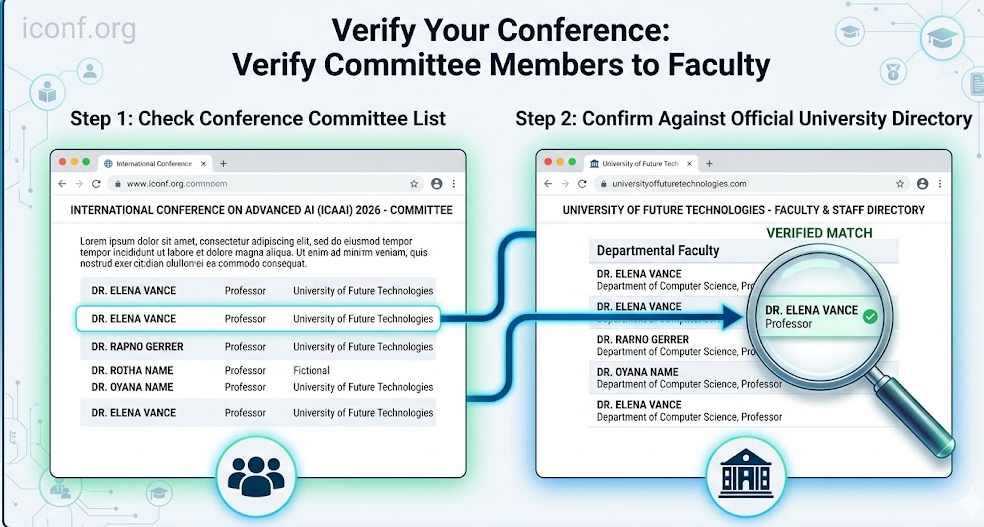
- Cross-Reference Institutional Profiles: Pick three names from the conference's "Program Committee" list. Go to their official university faculty web pages. Legitimate academics usually list the conferences they are organizing or chairing on their personal CVs or department pages.
- Contact the Committee Directly: If you are unsure, find a committee member's official university email address (do not use the email provided on the conference site). Send them a brief, polite email asking: "I am considering submitting a paper to [Conference Name]. I saw you are listed as a Program Chair and wanted to verify if you are actively involved with this event." If they reply that they have no idea what the conference is, report the website and do not submit your work.
3. Scrutinize the Peer Review Process
Legitimate academic publishing requiresrigorous, independent peer review. Fake organizers view peer review as anobstacle to collecting your money.
- Check the Timeline: Look at the "Important Dates" section. If the deadline for full paper submission is May 1st, and the "Notification of Acceptance" is May 5th, the conference is a scam. Proper peer review requires a minimum of three to six weeks.
- Review the Author Guidelines: Authentic conferences provide extensive, highly technical formatting guidelines (e.g., blind submission rules, specific LaTeX or Word templates, page limits). Predatory sites often have vague, one-paragraph submission instructions because they accept any format as long as the fee is paid.
4. Authenticate the Venue and Logistics
Predatory conferences often claim to behosted in famous tourist destinations or luxury hotels to entice researcherslooking for a "vacation" funded by their universities.
- The Hotel Concierge Test: If the conference website lists a specific 5-star hotel as the venue, find the hotel's official contact information on Google. Email the hotel's event management team and ask if "[Organizer Name]" has reserved conference rooms for those specific dates. Legitimate organizers sign venue contracts months in advance.
- Assess the Scope: Beware of conferences that combine wildly unrelated fields (e.g., "The International Conference on Medical Science, Business Management, and Civil Engineering") at a single venue. Real academic events are highly specialized.
5. Consult Trusted Blacklists andWhitelists
Finally, leverage the work of the broaderacademic community to verify the event.
- Think.Check.Attend: Use the standard checklist provided by the Think. Check. Attend. initiative, a global campaign designed to guide researchers in evaluating conference legitimacy.
- Your University Library: Consult your university's academic librarian. They have access to institutional whitelists and can quickly verify if a publisher or conference series is approved for graduation or tenure credits.