
Receiving an email from a Program Chair or Journal Editor with a decision of "Revise and Resubmit" (R&R) triggers a mix of relief and anxiety. You avoided an outright rejection, but your paper is not yet accepted.
Whether you are revising a manuscript from your university lab or finalizing your rebuttal document from a hotel room during a late March business trip to Yokohama, understanding exactly what the committee expects from you is critical.
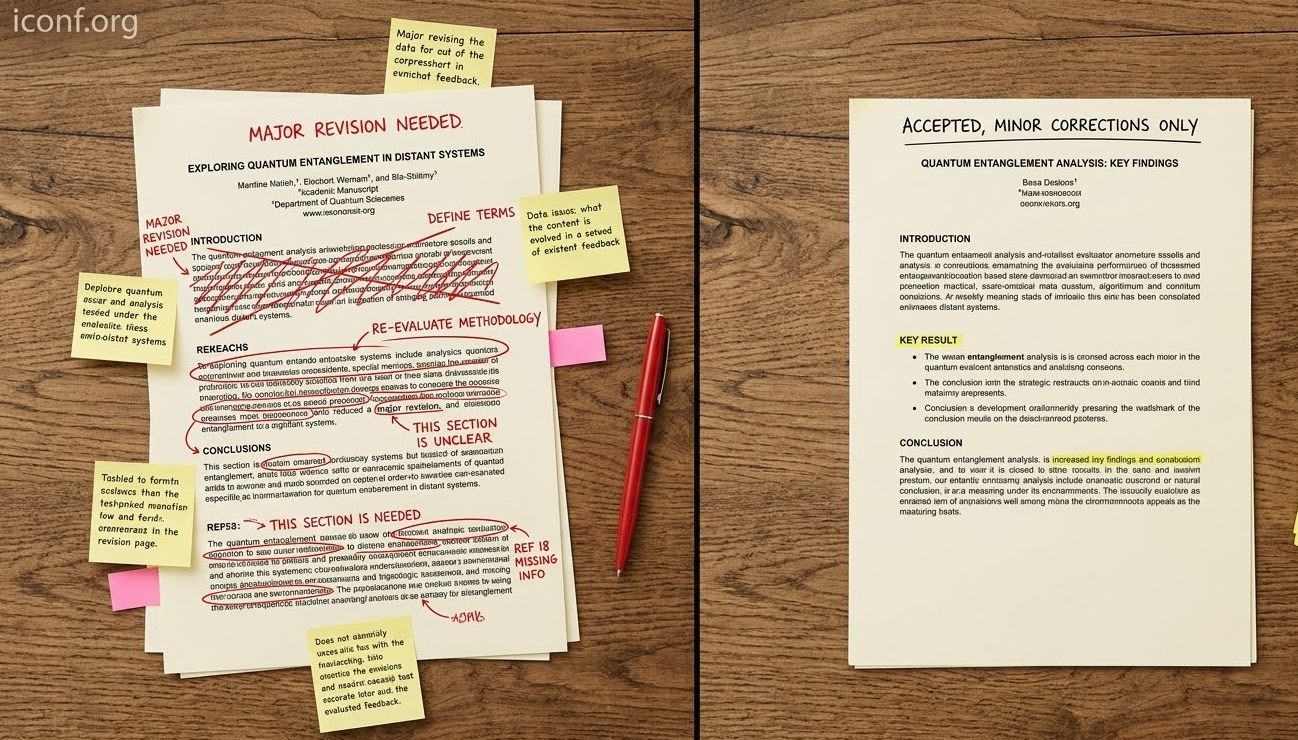
The workload, timeline, and statistical chances of final acceptance vary dramatically depending on whether you received a Minor Revision or a Major Revision. Here is a candid breakdown of what each status means and how to secure your publication slot.
A "Minor Revision" is the best realistic outcome for a first-round submission. It means the core science, methodology, and conclusions of your research are fundamentally sound. The reviewers agree that your paper is valuable to the field and should be published.
What is Required: Reviewers are asking for superficial or highly specific fixes. This typically includes:
Correcting typographical or grammatical errors.
Clarifying an ambiguous sentence in the abstract.
Adding one or two missing citations to the literature review.
Reformatting a chart or graph to improve readability.
Chances of Acceptance: Your chances of acceptance are exceptionally high—usually above 90% to 95%. As long as you respectfully make the requested changes and do not argue with the editor over trivial formatting rules, your paper will almost certainly be accepted. In many cases, the revised manuscript is evaluated only by the Editor-in-Chief rather than being sent back to the original reviewers, resulting in a very fast final decision.
A "Major Revision" means the reviewers see significant potential in your research, but the manuscript in its current state is scientifically or structurally flawed.
What is Required: This is not a formatting exercise; it is a heavy academic lift. Reviewers are typically demanding:
Re-running statistical analyses with a different mathematical model.
Expanding the dataset or sample size to prove statistical significance.
Completely rewriting the literature review to address a missing theoretical framework.
Toning down overly aggressive conclusions that are not fully supported by your data.
Chances of Acceptance: The chances of acceptance after a major revision are generally moderate to high, hovering between 50% and 70%. The outcome depends entirely on your work ethic.
If you attempt to take shortcuts, ignore difficult reviewer comments, or fail to provide a convincing counter-argument when you disagree with a reviewer, the paper will be rejected in the second round. Because major revisions require so much new work, the updated manuscript will always be sent back to the original peer reviewers for a second evaluation.
Regardless of whether your revision is major or minor, your success hinges on one document: the Response to Reviewers (often called a Rebuttal Letter).
You must submit a detailed document alongside your updated manuscript that addresses every single critique.
Be Methodical: Copy and paste every reviewer comment into a table. Below each comment, explicitly state how and where you altered the manuscript (e.g., "We have updated the methodology section on page 4, paragraph 2, to clarify the control group parameters.").
Be Respectful: Even if a reviewer misunderstood your point, never be defensive. Politely clarify the misunderstanding and update your text to ensure future readers do not make the same mistake.
You Can Disagree: You do not have to make every single change a reviewer demands, especially in a Major Revision. However, if you refuse a change, you must provide a highly detailed, scientifically backed justification in your response letter.
Understanding these nuances helps you manage your time and publication pipeline effectively. When planning your next submission strategy, utilizing trusted, highly curated academic directories such as