
Standing at a podium to deliver your first international academic presentation is a defining career moment. After months of research, writing, and navigating the peer-review process, it is time to share your findings with a live audience of global experts.
However, writing a great paper and delivering a great presentation require completely different skill sets. An academic paper is designed to be read meticulously; a presentation is designed to be absorbed instantly.
If you want to leave a lasting impression, avoid the common traps that plague first-time presenters. Here is a comprehensive guide to structuring your deck, mastering your delivery, and surviving the Q&A session.
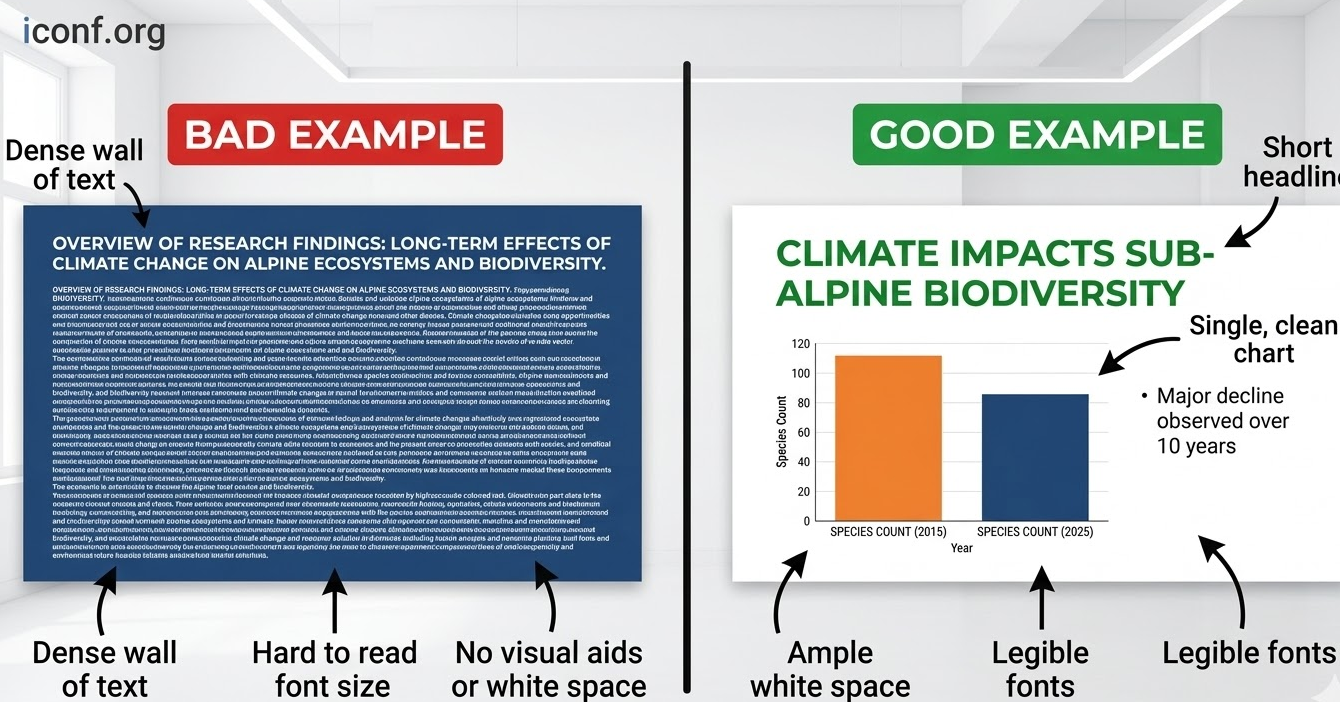
The most frequent mistake first-time presenters make is treating their slides as a teleprompter. Your slides are not your script; they are visual aids to support your narrative.
The One-Minute Rule: A standard conference presentation lasts 15 minutes (12 minutes for speaking, 3 minutes for Q&A). Plan for exactly one slide per minute. A 12-slide deck forces you to be concise.
Kill the Wall of Text: No slide should contain more than 30 words. If the audience is reading a massive paragraph on the screen, they are not listening to what you are saying.
Headline Phrasing: Instead of using generic slide titles like "Results," use declarative headlines that tell the audience exactly what they are looking at, such as "Algorithm X Outperforms Algorithm Y by 15%."
Simplify Complex Data: Do not screenshot a massive, dense table directly from your manuscript. Recreate the data as a clean, highly visible bar chart or line graph highlighting only the specific variables you are actively discussing.
A presentation should tell a story. You cannot possibly explain every detail of a 10-page paper in 12 minutes, so you must aggressively filter your content.
Structure your 12 minutes using this proven narrative arc:
The Hook & The Gap (2 mins): What is the broad real-world problem? What is the specific gap in the current literature that your research addresses?
The Methodology (3 mins): Briefly explain how you conducted the research. Do not get bogged down in standard protocols unless your novel contribution is the methodology itself.
The Core Findings (5 mins): This is the heart of your presentation. Show your most impactful data. Walk the audience through the charts step-by-step (e.g., "On the X-axis we have time, and on the Y-axis we have error rates...").
The Conclusion & Future Work (2 mins): Summarize the main takeaway in one sentence. State the limitations of your study and outline what your lab plans to do next.
How you say it is just as important as what you are showing. International conferences are filled with attendees who speak English as a second or third language. Clarity is your greatest asset.
Pace Yourself: Adrenaline will make you speak 20% faster than you do in practice. Make a conscious effort to slow down, enunciate clearly, and pause between slide transitions.
Face the Audience: Never turn your back to the audience to read directly off the projection screen. Use the presenter display on the laptop in front of you, or rely on your practiced memory.
Rehearse Out Loud: Thinking about your presentation is not practicing. You must stand up, use a clicker, and speak out loud with a timer running. Do this at least five times before you travel.
The Q&A session is the most intimidating part of the presentation, but it is also where the best networking happens.
Listen and Repeat: When an audience member asks a question, repeat it into the microphone before answering. This buys you a few seconds to think and ensures the rest of the room heard the question.
Be Concise: Answer the specific question asked. Do not use a question as an excuse to launch into another five-minute presentation.
How to Say "I Don't Know": It is perfectly acceptable to not have an answer. Never invent data on the spot. Simply say: "That is a fascinating perspective that we haven't tested yet. I'd love to exchange contact information after the session to hear more about how you would approach that variable."