
When you begin searching for academic conferences to present your research, you will quickly notice that organizers use two different terms to solicit submissions: Call for Abstracts (CFA) and Call for Papers (CFP).
While people sometimes use these terms interchangeably in casual conversation, they represent two entirely different submission processes, require different levels of effort, and result in different academic outcomes.
Understanding the distinction is critical for managing your time and ensuring your research is published in a format that benefits your career. Here is a definitive breakdown of the differences.
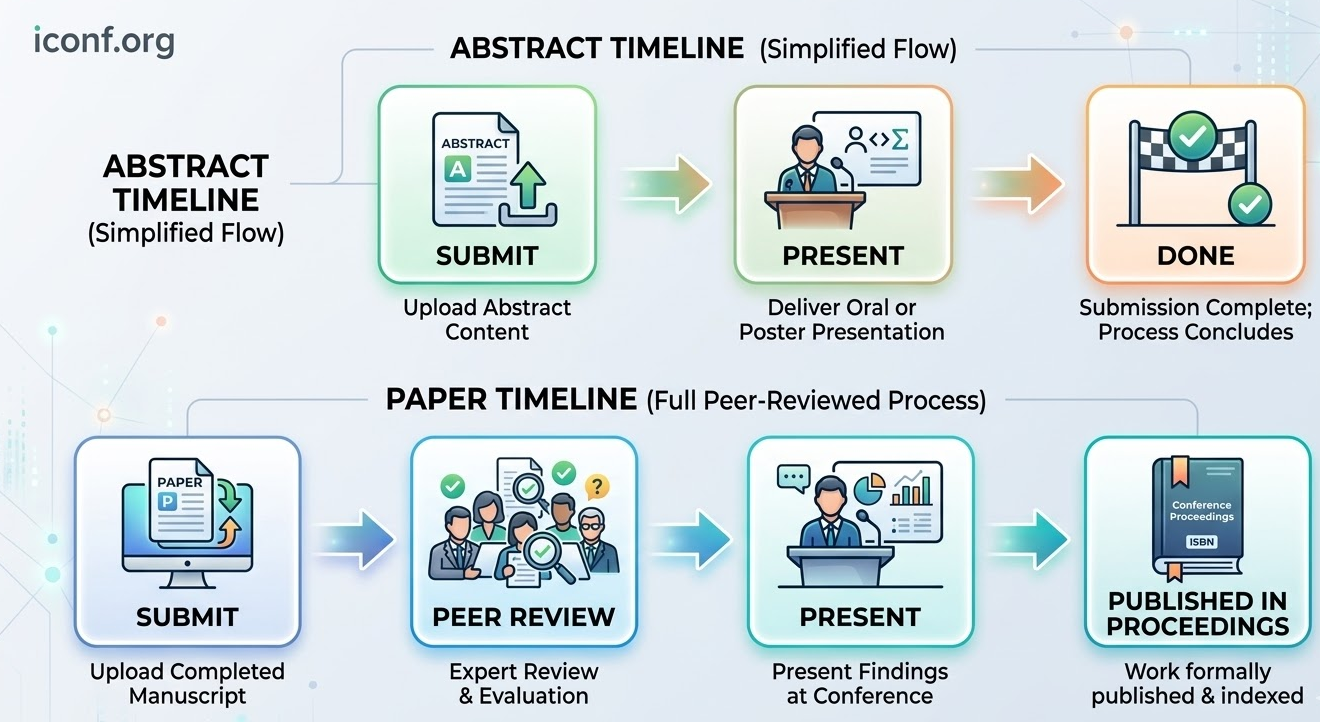
A Call for Abstracts is an invitation to submit a brief summary of your research—typically ranging from 250 to 500 words.
The Purpose: The organizing committee uses this short summary to determine if your research topic is relevant to the conference theme and interesting enough to warrant a presentation slot (either an oral presentation or a poster).
Key Characteristics:
Low Barrier to Entry: You do not need a finished manuscript to submit an abstract. In many fields (especially medicine and biology), researchers submit abstracts based on preliminary data before the full study is completely written up.
Fast Review Process: Because the committee only reads a few paragraphs, the review turnaround is usually very quick.
No Formal Publication: If accepted, you will present your work at the conference. However, the abstract is typically only printed in a "Book of Abstracts" distributed to attendees. It does not count as a formally published, peer-reviewed journal article or proceeding.
A Call for Papers is an invitation to submit a complete, fully written, and formatted academic manuscript—typically ranging from 4 to 10 pages, complete with data, charts, and a full bibliography.
The Purpose: The committee is looking for completed research that is ready to undergo rigorous academic scrutiny and eventual official publication.
Key Characteristics:
High Barrier to Entry: You must have entirely finished your research, analyzed the data, and written a comprehensive manuscript formatted to the publisher's strict guidelines (e.g., IEEE or Springer templates).
Rigorous Peer Review: The submission undergoes a formal, often double-blind, peer-review process by multiple experts in the field. This takes several weeks or months.
Formal Publication: If accepted, you will present the work, and the full manuscript will be officially published in the "Conference Proceedings." This is indexed in global databases (like Scopus or EI Compendex) and counts heavily toward your academic CV and graduation requirements.
| Feature | Call for Abstracts (CFA) | Call for Papers (CFP) |
| Length | 250 – 500 words | 4 – 10+ pages |
| Stage of Research | Can be preliminary or ongoing | Must be completed and finalized |
| Review Process | Editorial review for relevance | Formal, multi-reviewer peer review |
| Final Output | Book of Abstracts (Internal) | Conference Proceedings (Globally Indexed) |
| Academic Weight | Light (Proof of presentation) | Heavy (Counts as a published paper) |
Note: Some computer science and engineering conferences use a hybrid "Two-Phase" model. They first issue a Call for Abstracts to pre-screen ideas, and if your abstract is approved, they invite you to submit the full paper for peer review. Always read the conference guidelines carefully.
The choice between submitting an abstract or a full paper depends entirely on your current academic goals and the norms of your specific discipline.
Choose a CFA if: You have exciting preliminary data you want to share, you are looking for live feedback from peers before writing the final manuscript, or you are in a field (like the humanities or clinical medicine) where journals are the only respected publication venue and conferences are purely for networking.
Choose a CFP if: You are in computer science, engineering, or physics, where conference proceedings are highly prestigious and function exactly like journal publications. You should also target CFPs if you urgently need a published, indexed paper to meet university graduation or funding requirements.